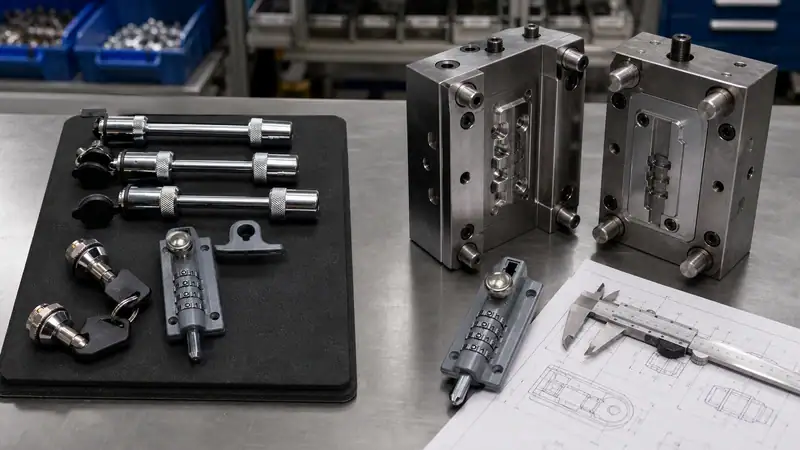
An existing lock design normally has the lower upfront cost. Custom tooling can create value through better fit, fewer parts, lower assembly cost, or a protected product advantage. Compare development cost, unit cost, validation, lead time, commercial terms, change risk, tooling ownership, and expected product life before deciding.
What Counts as an Existing Lock Design?
An existing design uses available tooling, fixtures, drawings, and production processes. Common customization includes:
- Logo or laser marking.
- Color or surface finish.
- Key combination and keying plan.
- Shackle, cam, tailpiece, rod, or accessory.
- Packaging and instructions.
- Minor dimensions that do not require a new primary mold.
Because the core components already exist, sampling and production can begin faster. The manufacturer also has more experience with assembly, tolerances, and common failure points.
A proven platform can still be configured for an OEM customer without building every component from zero.
What Is a Custom Mold Project?
A custom mold project creates new tooling for one or more unique parts. Depending on the lock, tooling may be needed for die-cast bodies, plastic housings, stamped components, keys, covers, knobs, or other parts.
The development process normally covers requirement definition, design and tolerance review, prototyping, mold manufacture, trials, correction, testing, and pilot production before final approval.
Tooling is only one cost. Engineering time, prototypes, test samples, fixtures, gauges, packaging development, and revisions should also be included in the business case.
What Determines Custom Lock Mold Cost?
Existing designs avoid the main tooling investment. The buyer may only pay for samples, logo setup, packaging plates, or minor fixtures.
A custom design requires non-recurring engineering and tooling charges before saleable units are produced. The amount depends on:
- Number and complexity of new parts.
- Material and manufacturing process.
- Tool life and expected production volume.
- Surface requirements.
- Dimensional tolerance.
- Number of cavities.
- Prototype method.
- Test and certification requirements.
- Changes requested after tooling begins.
Ask for a breakdown of design, prototype, tooling, sample, test, and revision responsibilities—not only one “mold cost” line.
Unit Cost and Break-Even Volume
Custom tooling can lower unit cost by eliminating machining, combining parts, shortening assembly, or reducing material. Unusual materials, tight tolerances, low-volume components, and complex inspection can raise it.
A basic break-even calculation is:
Break-even quantity = Total custom development cost ÷ Unit savings compared with the existing design
Use project-specific quotations for the calculation. The tooling-only result should then be adjusted for financing, inventory, testing, delays, warranty risk, assembly savings, and the commercial value of a differentiated product; it should not be treated as a universal volume threshold.
Lead Time Differences
Existing designs usually reach production faster because core tooling and process parameters already exist. The main tasks are configuration, branding, sample approval, and scheduling.
Custom projects require design review, prototypes, tooling, trials, corrections, testing, and pilot production. Include approval time in the schedule; late feedback and changing requirements often cause the longest delays.
If a launch date is fixed, an existing design may be the safer commercial decision even when a custom design looks better on paper.
Development and Quality Risk
A proven lock platform has production history. That does not remove the need for inspection, but it reduces uncertainty about mold filling, component fit, assembly, and normal operation.
A custom lock introduces new interactions. Typical risks include molding distortion, tolerance stack-up, surface defects, insufficient clearance, weak fastening points, moving-part interference, and packaging damage.
Use design reviews, prototypes, trial samples, and pilot runs before mass production. Reserve time and budget for at least one correction cycle.
When an Existing Design Is the Better Choice
Choose an existing platform when:
- You need to launch quickly.
- Annual volume is uncertain or relatively low.
- Standard dimensions meet the application.
- Your differentiation is branding, packaging, service, or distribution.
- You are testing a new market.
- The customer accepts a proven catalog configuration.
- Tooling investment would consume too much working capital.
Existing models are useful for first-generation products because field feedback reveals which features deserve customization later.
When a Custom Mold Makes Financial Sense
Custom tooling becomes more attractive when:
- No existing lock fits the installation envelope.
- A special coin, token, cam, cylinder, mounting pattern, or user flow is required.
- Expected lifetime volume is high enough to recover development cost.
- A lower part count or faster assembly can create meaningful savings.
- The product needs a unique appearance or protected interface.
- The buyer controls stable technical requirements.
- The new design supports a long-term product family.
Customization should solve a measurable problem, not merely change appearance.
A Third Option: Modify a Proven Platform
Many projects do not need a fully new lock or a completely standard product. A hybrid approach can keep the existing cylinder, key system, springs, and internal mechanism while creating a new housing, cam, bracket, cover, or mounting plate.
This approach can reduce tooling scope, preserve proven internal performance, shorten validation, create an application-specific fit, and limit spare-parts complexity.
Ask the manufacturer to separate “must be custom” features from “can remain standard” components.
Tooling Ownership and Commercial Terms
Before paying for tooling, clarify:
- Who legally owns the mold?
- Is the tooling exclusive to the buyer?
- Where will it be stored?
- Who pays for maintenance and repair?
- What production volume or time defines tool life?
- Can the mold be transferred?
- Who owns drawings and design files?
- What happens if the project stops?
- Are replacement inserts included?
- How will design changes be approved and charged?
Tool ownership does not automatically mean the buyer owns every underlying mechanism or supplier process. Put the agreed scope in writing.
How to Compare Quotations Correctly
Request the same cost structure from each supplier: engineering, prototypes, tooling by component, fixtures and gauges, trials, unit-price assumptions, packaging, testing, expected tool life, staged lead times, and included revision rounds.
Then calculate total cost at several volume scenarios.
Practical Decision Framework
Step 1: Define the non-negotiables
List installation dimensions, operating method, security requirement, appearance, environment, target cost, and launch date. Separate required features from preferences.
Step 2: Screen existing designs
Test actual samples. A small bracket, cam, shackle, tailpiece, or packaging change may solve the problem without a full new mold.
Step 3: Estimate lifetime volume
Use conservative, expected, and optimistic scenarios. Include replacement and follow-on orders only when there is evidence.
Step 4: Calculate total cost
Combine tooling, engineering, unit cost, testing, inventory, and expected quality risk. Consider the financial cost of a delayed launch.
Step 5: Confirm ownership and change control
Agree on drawings, sample approval, tooling ownership, revision limits, and mass-production acceptance criteria before tooling starts.
Cost Decision
Use an existing lock design when speed, low upfront cost, proven performance, and demand flexibility matter most. Choose a custom mold when the application cannot be served by existing hardware or when volume, unit savings, product differentiation, and long-term value justify development.
ANLI LOCK has supplied lock products since 1998 and supports development from concept through production. Its capabilities include requirement and tolerance review, prototyping, tooling coordination, die-casting, CNC machining, stamping, surface finishing, laser engraving, assembly, inspection, and packaging. Send drawings, samples, installation constraints, performance requirements, and branding needs through the contact page for an existing-platform, modified-platform, or fully custom assessment.
ANLI’s Custom Lock Project Experience
ANLI has supplied customized industrial and electrical-cabinet lock solutions to OEC. This project experience demonstrates our ability to translate equipment-specific requirements into practical lock designs, from mounting interfaces and operating mechanisms to materials, finishes, and production details.

Have a lock requirement that standard products cannot meet? Send ANLI your drawing, sample, installation constraints, and performance requirements. Our engineering team will assess whether to modify a proven platform or develop a fully customized solution.
RFQ Information for a Custom Lock
Provide:
- Application and installation drawing.
- Target markets and use environment.
- Required dimensions and interfaces.
- Desired mechanism and key system.
- Material and finish.
- Performance and test requirements.
- Existing reference samples.
- Target unit price.
- Expected product life and commercial program.
- Launch date.
- Intellectual-property and tooling-ownership expectations.
- Packaging and labeling needs.
These inputs allow the manufacturer to compare existing, modified, and fully custom options on the same basis.