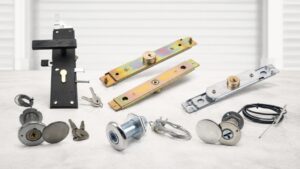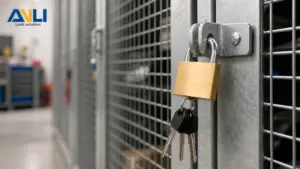
A center lock sits near the middle of the door and moves rods, cables, or latches toward both sides. A side lock sits near an edge and drives a bolt into a track, guide, frame, or keeper; some doors use one, while others use a pair.
Choose between them by door movement, available locking points, outside-access requirements, panel construction, and installation space. Security also depends on rod length, keeper alignment, cylinder exposure, fasteners, and panel reinforcement.
Quick Comparison
| Factor | Center Garage Door Lock | Side Garage Door Lock |
| Typical position | Near the middle of the door | Near one or both door edges |
| Locking action | Operates rods, cables, or latches toward the sides | Projects a bolt into a track, frame, or keeper |
| User operation | Convenient single control point | One lock per side, or one local locking point |
| Installation scope | More components and alignment work | Usually simpler local installation |
| Best fit | Doors designed around a central linkage | Doors with accessible tracks or edge frames |
| Main risk | Linkage or rod misalignment | Bolt-to-keeper misalignment or uneven locking |
How a Center Garage Door Lock Works
A center lock converts one key movement into locking action at two points. On many manually operated garage doors, horizontal rods extend from the lock case toward the left and right sides. On other designs, the center mechanism pulls cables connected to latches.
One key controls both sides and distributes the load across two engagement points. The lock case, spindle, rods or cables, guides, springs, latches, and keepers must all align. A bent or poorly supported rod causes stiff operation; door movement can make one side engage before the other.
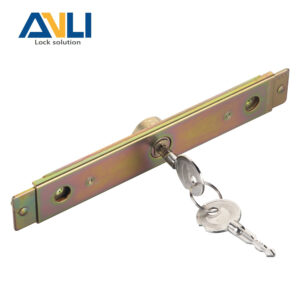
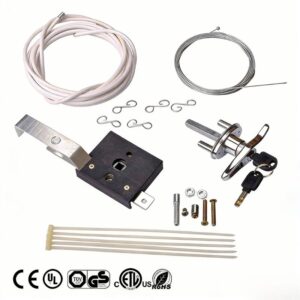
Center locks work best when the door manufacturer and lock supplier coordinate the complete assembly. ANLI can adapt the lock case, spindle, rods or cables, guides, latches, keepers, mounting pattern, and operating direction to the customer’s door structure after reviewing drawings or samples.
How a Side Garage Door Lock Works
A side lock uses a short bolt or latch to engage a keeper, guide rail, or prepared opening close to the track. It suits doors without space for a center linkage and retrofit projects that cannot accept full-width rods.
If both sides need independent locking, the user must operate two devices. With only one side lock, the opposite edge relies on the door and track to control flex.
Application Differences
Center locks are often preferred for manually operated up-and-over doors, certain sectional doors, and roller or shutter systems designed with a central operating mechanism. They work well when:
- One key operation should control two locking points.
- The door panel has enough strength and space for rods or cables.
- The manufacturer can pre-punch mounting holes and install rod guides.
- External key access and internal handle operation are both required.
Side locks are often a better fit for roller shutters, commercial roll-up doors, storage units, and retrofit applications. They are practical when:
- The bolt can engage directly with a side guide or frame.
- A simple internal lock is acceptable.
- The installation must avoid a long linkage.
- Independent left and right locking is desirable.
Locks sold under the same product name may fit different panel profiles, tracks, and operating systems. Treat the center-lock and side-lock categories as starting points: check the installation drawing, then confirm which dimensions or components need to be customized for the actual door.
Installation Details to Specify
Mounting position and drilling
A center lock needs a controlled reference point on the door. The lock body must sit square, and rod or cable paths must remain level and unobstructed. Hole positions should be defined in a drawing or drilling template.
A side lock requires less travel, but the bolt must meet the keeper accurately. Specify the panel-edge distance, bolt projection, keeper position, and track clearance.
Rod, cable, and bolt alignment
Center systems are sensitive to cumulative tolerance. Small errors at the lock body, rod guide, latch, and keeper can add up. Test the system through the complete opening and closing cycle, not only with the door stationary.
Side locks have fewer components, but they are sensitive to local alignment. A bolt that rubs the track may become difficult to operate, especially after dirt, corrosion, or door movement changes the gap.
Inside and outside access
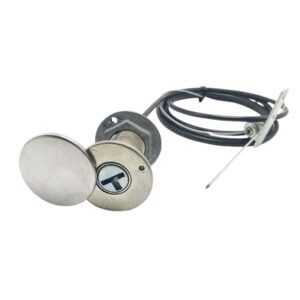
Some garages require keyed access from outside. Others only need an internal slide bolt because the main entrance is elsewhere. Confirm which side of the door receives the cylinder, whether an escutcheon is required, and whether an internal release must remain available.
An electrically operated door may need an emergency release. The controls should prevent the motor from running while the mechanical lock is engaged.
Fasteners and panel reinforcement
Thin sheet metal can deform around an otherwise strong lock. For both designs, verify fastener type, backing plates, reinforcement, and resistance to loosening. Security should not depend on small screws installed in unsupported sheet.
Which Design Is More Secure?
A two-point center lock resists edge movement only when its rods, latches, and mounts are strong. A heavy side bolt engaging a reinforced guide can outperform a light center assembly.
Evaluate the complete attack path:
- How far does the bolt or latch engage?
- Can the exposed cylinder be gripped, drilled, or struck?
- Are rods or cables reachable through a gap?
- Can the door panel flex enough to release the locking point?
- Are keepers attached to structural material?
- Will corrosion reduce movement or weaken components?
Outdoor installations also need suitable materials and finishes. Stainless steel, galvanized steel, plated components, and weather-resistant coatings serve different cost and corrosion requirements. Ask the supplier what test method and acceptance criteria apply instead of relying only on the word “weatherproof.”
Contact ANLI – Trusted by SOMMER, DoorHan, Nice, and ALUTECH
ANLI LOCK develops and manufactures garage door locks, roller shutter locks, emergency locks, bottom locks, and complete lock kits for OEMs, distributors, and building-hardware buyers. Existing mechanisms can be adjusted, or application-specific parts can be developed, to match the door profile, linkage travel, mounting pattern, material, finish, key system, accessories, branding, and packaging. Send the door type, dimensioned drawing or sample, operating requirements, and target market for an engineering review.
ANLI has supplied customized garage-door lock solutions to customers including SOMMER, DoorHan, Nice, and ALUTECH. These projects reflect our ability to match different door structures, operating mechanisms, installation dimensions, finishes, and keying requirements.




Planning a new garage-door lock or replacing an existing design? Send ANLI your door drawing, lock sample, and operating requirements. Our team will recommend a proven platform or develop the custom parts needed for your application.
Specification Checklist for OEM and Wholesale Buyers
Before requesting a quotation, provide:
- Door type, panel profile, and track or guide dimensions.
- Center or side mounting location.
- Door width and thickness.
- Required bolt, rod, or cable travel.
- Inside-only or inside/outside operation.
- Cylinder type and key system.
- Material and surface finish.
- Left-hand, right-hand, or reversible operation.
- Required accessories, including rods, guides, keepers, handles, and fasteners.
- Packaging method and whether components must be pre-assembled.
- Target market and delivery requirements.
Use dimensioned drawings or physical samples; photographs alone rarely show critical clearances.