Salt spray testing for garage door locks checks how a finished lock assembly responds to controlled salt fog. It can reveal weak plating, coating pores, exposed steel and vulnerable joints. It cannot convert test hours into an exact number of outdoor years. Buyers should define the method, samples and pass criteria before testing.
What Happens During a Real Salt Spray Test?
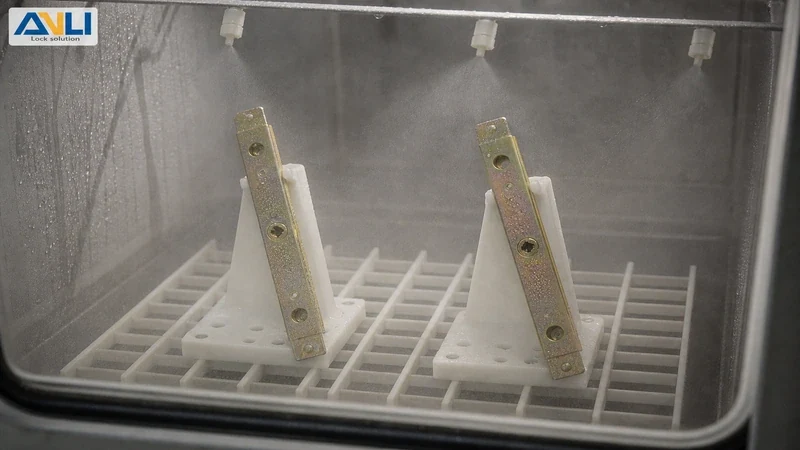
A laboratory places cleaned samples in a closed salt-fog chamber. The samples sit at a defined angle and do not touch each other. A salt solution is atomized into a fine, continuous fog. The laboratory controls chamber conditions and collects fallout to confirm that the exposure stays within the chosen method.
The samples remain exposed for the time stated in the product specification. Staff inspect them at agreed intervals when the method allows. At the end, the laboratory follows the specified cleaning and drying procedure. It then records corrosion and checks lock operation.
Two common references are ASTM B117 and ISO 9227. These documents describe the test environment. They do not choose the correct exposure time or pass criteria for a garage-door lock. The buyer’s product specification must do that.
What Does Salt Spray Testing for Garage Door Locks Reveal?
The test can expose discontinuities in plating, paint and other protective finishes. It can also show corrosion at edges, seams, fasteners and dissimilar-metal joints. These areas often fail before a large flat surface.
A garage-door lock contains several materials. The cylinder, housing, bolt, cam, cable, handle, springs, screws and mounting plate may all use different protection. Corrosion in one small part can stop the key, cable or latch. Test the production-intent assembly, not only a plated coupon.
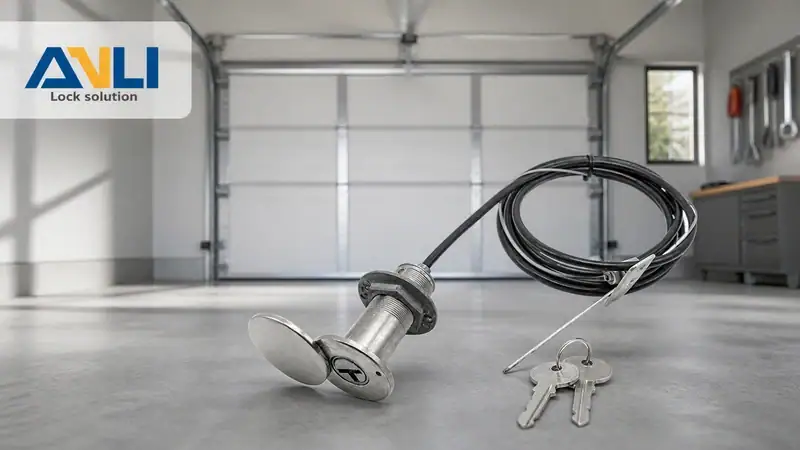
ANLI’s garage-door and roller-shutter lock range includes keyed assemblies, internal shutter locks, emergency-release locks and cable designs. The selected material and finish should match the door location and expected exposure.
How Should Buyers Define Salt Spray Testing for Garage Door Locks?
| RFQ item | What to state |
| Test reference | Current customer protocol, ASTM B117, ISO 9227 or another named method |
| Exposure | Inland, coastal, industrial, sheltered, direct weather, de-icing salt or cleaning chemicals |
| Samples | Final coating, cylinder, bolt/cam, cable, fasteners and mounting hardware |
| Duration | The exact exposure period required by the product specification |
| Visual criteria | Permitted red rust, white corrosion, blistering, delamination or staining |
| Functional criteria | Key rotation, cable travel, latch release, relocking and acceptable operating force |
| Reporting | Photos, inspection intervals, affected areas, replicate results and final disposition |
Do not write only “salt spray passed.” That phrase omits the method, time, sample and acceptance rule. It gives procurement teams no reliable basis for comparing suppliers.
Why Post-Test Function Is Essential
A lock can look acceptable and still bind. Corrosion products may build inside the cylinder or around a sliding part. A cable end may seize. A spring can lose movement. Require a functional check after the exposure and after the specified recovery period.
For salt spray testing for garage door locks, the final report should connect each visual defect to the affected part. It should also show whether the complete operating sequence still works.
Use a representative door panel when mounting affects drainage or load. Protect or expose cut edges exactly as the product specification states. Record key torque or operating force if the project has a limit.
Why Test Hours Do Not Equal Outdoor Service Years
Salt fog is continuous and controlled. Real service includes wet and dry periods, UV light, temperature changes, dust, vibration and maintenance. Water may collect in a door cavity. Local chemicals may be more or less aggressive than the chamber environment.
ASTM states that stand-alone salt spray results do not reliably predict natural-environment performance. ISO also explains that its methods are not intended to predict long-term corrosion resistance. Use the result to check production quality against a defined requirement. Add field trials or cyclic corrosion testing when the risk justifies it.
Which Other Checks Support Outdoor Validation?
- Cycle testing before and after corrosion exposure.
- Water-ingress and drainage checks on the installed door.
- Key, handle, bolt and cable operating-force checks.
- Temperature and wet/dry cycling where required.
- Vibration or door-slam testing for the actual assembly.
- Field trials in the target climate.
Garage-Door Program Experience
ANLI has supplied garage-door lock products for customers including SOMMER, DoorHan, Nice and ALUTECH. This experience has helped our team understand the practical requirements of door fit, outdoor exposure, keying and consistent mass production. Each new lock is still developed and tested against the buyer’s drawings and performance requirements.




Validate Your Outdoor Lock Specification With ANLI
Send ANLI your door drawing, exposure category, test method, pass criteria, finish, keying and annual volume through the contact page. We can prepare a production-intent sample and plan salt spray testing for garage door locks around the actual project.
Frequently Asked Questions
Does a 500-hour result mean 500 days outdoors?
No. There is no universal conversion from chamber hours to outdoor days or years. The result only applies to the stated method, sample and acceptance criteria.
Should buyers test separate parts or the complete lock?
Use the complete production-intent assembly when possible. Separate coupons can support coating control, but they do not show joint corrosion or post-test lock function.
What is the most useful pass criterion?
Salt spray testing for garage door locks needs both visual and functional criteria. Define allowed corrosion by area and require the key, bolt, cam or cable to operate after the test.