
Every day, we perform a thousand tiny physical interactions with the world around us. Among the most ubiquitous of them is the simple act of opening a door. The door handle is so ingrained in our daily existence that we rarely pause to consider its origins. In fact, this innovation did not happen overnight; it was a slow progression from leather straps and wooden bars to the high-precision hardware we see today. At the heart of this story is a brilliant African American inventor named Osbourn Dorsey.
Read on to learn the full story of the door handle and its journey to our modern homes.
Before the Handle
Long before the modern door knob was a standard feature, early civilizations had to find creative ways to secure their dwellings. The earliest wooden doors were often simple slabs of timber held in place by heavy stones or wooden beams. In ancient times, the Egyptians were among the first to develop recognizable hinge systems and complex locks, but the average person’s home remained much simpler.
For centuries, people used a “latch-string” system. This was a primitive internal door latching mechanism. A wooden bar on the inside of the door was lifted by a string passed through a small hole. If you wanted to lock the door, you simply pulled the string inside. To pull the door open from the outside, the string had to be left hanging—hence the welcoming phrase, “the latch-string is always out.” In some regions, simple bronze or iron rings have begun to be used.

These early designs emerged in response to the needs of the era: they were heavy, durable, and purely functional. There was little thought given to the decorative aesthetics we value now; the goal was simply to keep the exterior doors shut and the occupants safe.
The 19th Century Revolution
As the 1900s approached, the Industrial Revolution greatly transformed the methods of manufacturing hardware. What was once the bespoke work of a local blacksmith became a product of mass production. This era saw a dramatic trend toward more complex styles and finishes, including the use of brass, glass, and porcelain. However, even with these aesthetic upgrades, the internal mechanics remained clunky until the mid-to-late 19th century.
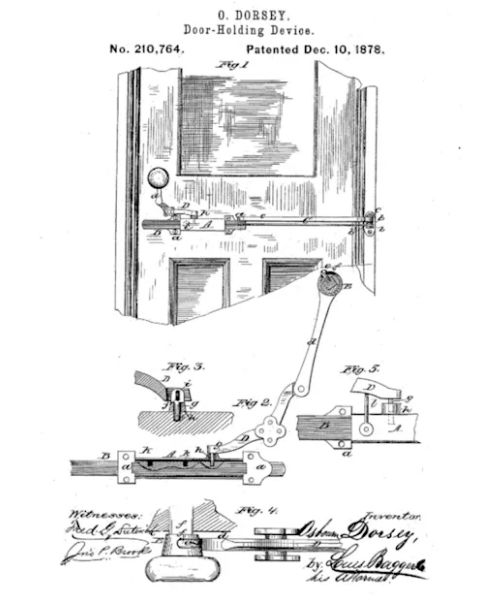
In 1862 and the years following, as inventors began filing more sophisticated designs to the patent office, the development of hardware products reached a pivotal moment. However, the most significant leap occurred in 1878. An inventor named Osbourn Dorsey registered the first truly modern door knob assembly. Before Dorsey’s invention, door knobs and handles were often just decorative pulls that didn’t necessarily operate a latching bolt in a synchronized way.
Dorsey’s invention of the door handle mechanism (Patent #210,764) introduced a system where the turning of a knob or the pressing of a lever would retract a bolt. This allowed the door to stay shut without being locked, providing a new level of privacy and convenience for interior rooms. His work was a masterclass in functional innovation. Because of his contribution, the modern door knob became a standardized reality, moving away from the era of the latch-string and into the age of mechanical precision.
The 20th Century and Beyond
Following the invention of door systems by Dorsey and his contemporaries, the 20th century saw the artistic evolution of door handles. As architectural movements such as Art Deco and Modernism swept across Europe and America, the lever handle began to gain prominence over the circular knob. In most parts of Europe, lever handles became the standard because they were easier to operate for people of all ages and abilities.
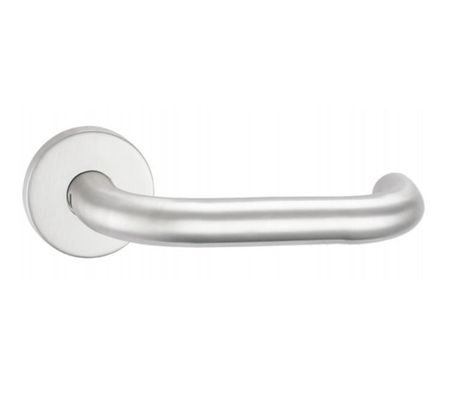
During this time, the materials used also evolved over time. We moved from heavy bronze and brass to lighter alloys and eventually plastics and stainless steel. The design also increasingly embodied the minimalist values of the mid-century modern era. It wasn’t just about opening a door anymore; it was about the tactile experience. The key transition in this period was the focus on ergonomics—ensuring that the handle fit the hand as perfectly as the door fit the frame.
The Door Handle Today
Today, the door handle is undergoing its next great evolution. We are moving away from purely mechanical devices toward digital and “smart” hardware. In many modern buildings, the key is being replaced by fingerprints, RFID cards, or smartphone apps.
Modern styles and finishes now offer endless variety, from decorative vintage designs to minimalist levers. Furthermore, we have rediscovered the benefits of older materials; for instance, brass and copper are being used again for their natural antimicrobial properties, which are crucial for the exterior doors of public spaces.
Frequently Asked Questions
Who made the first door handle?
The first modern patent for a door knob mechanism was granted to African American inventor Osbourn Dorsey in 1878, which standardized the design we recognize today.
What’s the difference between a door knob and a lever handle?
A knob requires gripping and twisting, while a lever only needs a push down. Levers are more accessible and are often required by building codes in public spaces.
Are brass door handles a good choice?
Yes. Brass is durable, naturally antimicrobial, and develops an attractive patina over time. It’s especially practical for high-touch or exterior doors.
What is the future of door handles?
Trends include touchless and smart entry systems (using phones, codes, or biometrics), integrated smart home features, and increased use of hygienic materials like copper alloys.
Conclusion
From simple latches to smart hardware, the evolution of the door handle embodies our enduring pursuit of safety, convenience, and design. Central to this story is Osbourn Dorsey, whose 1878 invention standardized the modern doorknob.
To learn more about the world of door handles, feel free to explore additional articles on our blog. And if you’re in search of a new door handle or other lock-related products, we invite you to browse our extensive product collection!